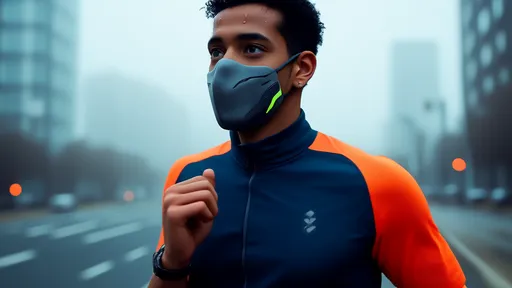
The early morning air hangs heavy, a thick blanket of gray obscuring the city skyline. For many dedicated runners, this is the daily reality – the choice between skipping a workout or braving the haze. The rise of urban pollution has turned the simple act of jogging into a health calculation, with more athletes questioning how to protect their lungs without sacrificing performance. This dilemma has spawned an entire industry of specialized masks promising to filter out harmful particles while allowing enough oxygen flow to sustain vigorous exercise.
Understanding the enemy is the first step toward defense. PM2.5 particles – those smaller than 2.5 micrometers – pose the greatest threat to runners. These microscopic invaders bypass the body's natural filtration systems, embedding deep in lung tissue and even entering the bloodstream. During aerobic activity, respiration rates triple or quadruple, dramatically increasing exposure. The paradox emerges: cardiovascular exercise strengthens the heart while potentially damaging the very lungs required to sustain it.
Traditional surgical masks offer false security on polluted mornings. Their loose fit allows unfiltered air to enter through the sides, while their material lacks the electrostatic charge needed to capture ultrafine particles. Marathoners in smog-choked cities have learned this the hard way, finishing long runs with blackened mucus – visible evidence of pollution bypassing inadequate protection. The market has responded with athletic-specific designs, but separating marketing hype from genuine innovation requires careful examination.
Breathability becomes the critical metric for running masks. Unlike stationary wear, where filtration efficiency dominates, runners must balance protection with oxygen delivery. High-intensity exercise demands up to 40 liters of air per minute – a volume that turns most N95 respirators into suffocating obstacles. Advanced designs now incorporate exhalation valves that reduce heat buildup and moisture retention, addressing the twin discomforts of sweaty fabric and labored breathing that plague conventional masks during exertion.
The geometry of protection reveals surprising complexities. A mask's seal determines its effectiveness more than its filter rating. Even the most advanced HEPA material fails when poorly fitted, as air follows the path of least resistance around rather than through the filtration media. Athletic face shapes present particular challenges – the combination of heavy breathing and repetitive jaw movement creates constant seal breakdown. Some manufacturers now offer silicone gaskets that conform to facial contours during motion, maintaining an airtight seal through every stride.
Material science innovations have produced filters that defy previous limitations. Electrospun nanofiber layers achieve high particle capture with minimal airflow restriction, while antimicrobial treatments combat bacterial growth in sweat-drenched fabric. The latest prototypes integrate smart sensors that monitor breathing patterns and pollution exposure in real time, though these technologies remain prohibitively expensive for most recreational runners. For now, the sweet spot lies in masks combining mechanical filtration with electrostatic attraction – capturing particles through both physical barriers and molecular adhesion.
Cultural attitudes shape mask adoption differently across running communities. In cities like Beijing or Delhi, where pollution levels frequently hit hazardous marks, masked runners draw no attention. Contrast this with Western cities where facial coverings still carry social stigma outside pandemic contexts. Professional athletes increasingly train in pollution masks to simulate high-altitude conditions, inadvertently normalizing their use. This trickle-down effect gradually changes perceptions, making respiratory protection more acceptable among amateur runners concerned about long-term health impacts.
The psychological barrier proves as formidable as the physical one. Many runners report initial sensations of suffocation when switching to filtered breathing, a phenomenon more related to anxiety than actual oxygen deprivation. Acclimatization requires patience – starting with short, easy runs while wearing the mask at home to adapt to the unfamiliar sensation. The mental adjustment period typically lasts two to three weeks, after which most athletes report the mask becomes unnoticeable during routine training.
Maintenance forms the often-overlooked component of effective mask use. A high-end respirator loses most of its protective value when filters go unchanged or when moisture accumulation compromises the electrostatic charge. Sweat salts crystallize in the filter media, creating channels that allow particulate matter to pass through unchecked. The cleaning routine matters as much as the original purchase – improper washing can permanently damage delicate filtration layers, while infrequent replacement turns the mask into a petri dish of microorganisms.
Urban planners increasingly recognize running masks as stopgap solutions rather than permanent fixes. Cities investing in green buffers along jogging paths and real-time air quality monitoring demonstrate more sustainable approaches. Some forward-thinking municipalities have installed outdoor air filtration systems in popular running areas, though these projects remain rare. Until systemic changes improve urban air quality substantially, the running mask market will continue evolving – pushing the boundaries of material science and respiratory physiology to protect athletes from an environment they refuse to abandon.
The dawn chorus of birds mixes with the rhythmic footfalls of determined runners, their faces now shielded by advanced filters as they move through the haze. This image captures our modern paradox – the human drive for health colliding with environmental degradation, and the technological solutions bridging the gap. As research continues, tomorrow's masks may become as lightweight and unobtrusive as running shoes, transforming from medical devices into standard athletic gear. For now, educated choices allow runners to keep chasing their personal bests without sacrificing long-term wellbeing to short-term air quality.

By /Aug 6, 2025

By /Aug 6, 2025

By /Aug 6, 2025

By /Aug 6, 2025

By /Aug 6, 2025

By /Aug 6, 2025
By /Aug 6, 2025

By /Aug 6, 2025

By /Aug 6, 2025
By /Aug 6, 2025

By /Aug 6, 2025

By /Aug 6, 2025

By /Aug 6, 2025

By /Aug 6, 2025

By /Aug 6, 2025

By /Aug 6, 2025

By /Aug 6, 2025
By /Aug 6, 2025
By /Aug 6, 2025

By /Aug 6, 2025
