The world of whipped toppings is a battleground of textures, techniques, and taste, where two primary contenders vie for dominance: dairy cream and its plant-based counterpart. For the professional pastry chef and the home baker alike, the choice between them often hinges not just on flavor or dietary preference, but on a fundamental, almost scientific property: stability. The journey from a liquid state to a voluminous, airy foam is a delicate dance of physics and chemistry, and the two creams perform this dance to entirely different rhythms. Understanding the nature of their stability—or lack thereof—is key to mastering their use in the kitchen.
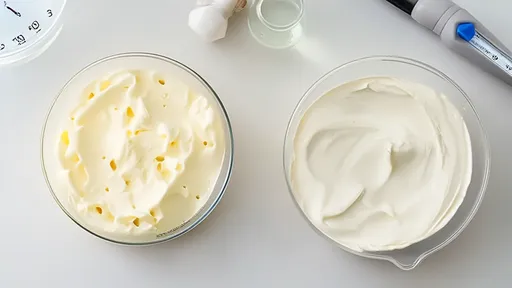
At its core, whipped cream is a foam, a colloidal system where millions of tiny air bubbles are trapped within a network of fat globules and water. The process of whipping incorporates air, and the fat particles, partially coalesced, form a fragile scaffolding around these bubbles, preventing them from escaping and collapsing the structure. The inherent stability of this foam is dictated by the very composition of the cream itself. Dairy cream is an emulsion of butterfat globules, each surrounded by a protective membrane of phospholipids and proteins, suspended in water. This specific architecture is the foundation of its whipping properties. The mechanical action of the whisk shears these membranes, allowing the exposed fat to clump together and create the necessary network. The higher the butterfat content, typically between 30% and 40% in heavy or double cream, the more robust and stable this network becomes. This natural fat structure provides a resilience that allows dairy whipped cream to hold its shape for hours at cool room temperature and even longer under refrigeration.
Plant-based creams, however, present a completely different biochemical landscape. They are engineered products, designed to mimic the mouthfeel and functionality of dairy without any animal derivatives. Their base can be derived from a multitude of sources: coconut, soy, oat, almond, or a blend of oils like palm, canola, and sunflower. The fundamental challenge is that these fats do not naturally exist in the perfect emulsified state found in milk. They are fundamentally oils that must be forced into a water-based matrix. To achieve this, manufacturers rely heavily on a cocktail of emulsifiers, stabilizers, and thickeners. Ingredients like soy lecithin, guar gum, xanthan gum, and carrageenan are not mere additives; they are the essential building blocks that attempt to replicate the structural role played by milkfat globules. They work to bind water and oil, increase viscosity, and hopefully, trap air. This synthetic scaffolding, while ingenious, is often inherently less robust than its natural dairy equivalent.
The most immediate and observable difference manifests in the whipping process itself. Whipping high-fat dairy cream has a relatively forgiving and predictable window. It moves from soft peaks to firm peaks, offering clear visual and tactile cues. Over-whipping leads to butter and buttermilk, a drastic but predictable failure state. Plant creams, in contrast, are notoriously fickle. Their window for perfect whipping can be astonishingly narrow, sometimes mere seconds. They can appear liquid one moment and then, with a few more turns of the whisk, suddenly become grainy, curdled, or separate into a watery mess and a greasy slop. This is because the stabilizer network, once over-agitated, can break catastrophically. The emulsifiers lose their grip, the oil separates out, and the entire foam collapses irreversibly. This demands constant vigilance and often a much slower, more gentle whipping speed.
Environmental factors further exaggerate the stability gap. Temperature is the most critical actor. Dairy cream whips best and is most stable when everything is ice-cold—the bowl, the whisk, and the cream itself. The cold keeps the milkfat solid, allowing the globules to maintain their structure as they coalesce, creating a strong, sharp network. Heat is its enemy, melting the fat and causing immediate slumping. Plant creams have a more complex relationship with temperature. While chilling is still beneficial, their stability is more dependent on the melting points of their constituent oils and the performance of their chemical stabilizers under thermal stress. Some, particularly those high in coconut oil (which is solid at room temperature), can paradoxically hold up better than dairy in warmer ambient conditions because their oil base remains solid at a higher temperature than milkfat. However, many others simply lack the structural integrity and will weep—releasing water—or deflate rapidly when not kept rigorously cold.
Time is another relentless foe, and it is here that the difference is most stark for a pastry chef preparing desserts in advance. A bowl of well-whipped dairy cream can sit in a refrigerator for a day and still retain a respectable portion of its volume and texture. It may soften slightly but rarely completely dissolves. Plant-based whipped toppings have a much shorter lifespan. Even under ideal refrigeration, they almost universally begin to degrade within a few hours. Syneresis, the separation of liquid from a gel, is a common issue, resulting in a pool of water at the bottom of the bowl and a foam that has shrunk and become spongy or rubbery. The chemical network simply cannot maintain its hold on the incorporated air and water indefinitely. This makes them a poor choice for applications where advance preparation is required, such as frosting a cake the day before an event.
The final application also dictates the choice. For a simple dollop on a pie served immediately, either can suffice, though the flavor profiles will differ. However, for complex constructions, the structural weakness of plant creams becomes a significant liability. Layering them in a trifle or using them to fill delicate pastries like eclairs is a risky endeavor. The weight of other components and the passage of time will almost certainly cause them to compress and leak moisture, leading to soggy, structural failures. Dairy cream’s stronger fat network provides the necessary support for such architectural endeavors in desserts. It can be folded into mousses or ganaches without immediately deflating, contributing to a lighter, more stable final product.
In conclusion, the divergence in stability between animal and plant-based creams is not a simple matter of one being superior to the other; it is a reflection of their fundamental natures. One is a natural, evolved emulsion with fat perfectly designed by nature to create and sustain a foam. The other is a marvel of modern food science, a clever but imperfect imitation built with chemical proxies. The dairy cream offers resilience, predictability, and endurance, born from its complex biological structure. The plant cream offers an alternative for specific dietary needs but demands a heightened level of technical skill, immediate use, and an acceptance of its transient nature. The informed baker must therefore choose not just based on ingredient preference, but with a clear understanding of the structural commitment each cream brings to the table, or more accurately, to the bowl.
By /Aug 20, 2025
By /Aug 20, 2025
By /Aug 20, 2025

By /Aug 20, 2025
By /Aug 20, 2025
By /Aug 20, 2025
By /Aug 20, 2025
By /Aug 20, 2025
By /Aug 20, 2025
By /Aug 20, 2025
By /Aug 20, 2025
By /Aug 20, 2025
By /Aug 20, 2025
By /Aug 20, 2025
By /Aug 20, 2025
By /Aug 20, 2025

By /Aug 20, 2025
By /Aug 20, 2025
By /Aug 20, 2025
By /Aug 20, 2025
