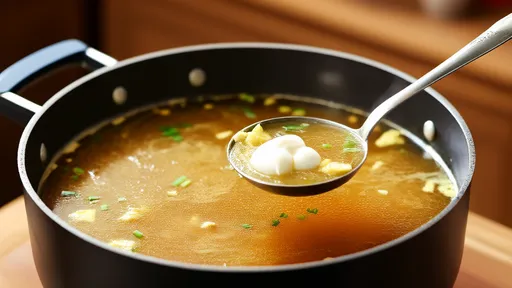
There is an almost meditative quality to watching a pot of stock come to life. First, the gentle simmer, a quiet prelude to the culinary symphony about to unfold. Then, the first signs of activity: tiny, off-white particles begin to separate from the bones and meat, clouding the water. Soon after, a frothy, greyish foam gathers on the surface, a seemingly undesirable scum that most recipes instruct you to diligently remove with a spoon. This act of skimming is one of the most fundamental, almost ritualistic steps in stock-making, passed down through generations of chefs and home cooks. But to view it merely as a cleaning step is to miss a fascinating display of food science in action, a process governed by the delicate and precise behavior of proteins when they meet heat.
The story of skimming is, at its core, the story of denaturation and coagulation. Proteins are not static, rigid structures; they are complex molecules intricately folded into specific three-dimensional shapes that determine their function. In their native state within muscle tissue or blood, these proteins are soluble, meaning they coexist peacefully dissolved or suspended in the water of the raw ingredients. However, heat acts as a powerful agitator. As the temperature of the water rises, the energy transferred to the protein molecules becomes too great for them to maintain their delicate folded structures. They begin to unravel, a process known as denaturation. Imagine a meticulously coiled rope being shaken violently until it unfurls; the protein's complex architecture breaks down, exposing parts of itself that were previously tucked safely away in its interior.
This unraveling is only the first act. The true transformation occurs when these denatured proteins begin to interact with each other. The newly exposed parts of the molecules are often hydrophobic, or water-fearing. In their quest to avoid the surrounding water, these hydrophobic regions desperately seek out other similar regions on neighboring protein molecules. They clump together, forming a network that traps water and air bubbles within it. This process is coagulation, and it is this aggregated mass of denatured proteins that rises to the surface as the foam or scum we so assiduously skim away. The initial foam is typically light in color—whitish or tan—comprised largely of albumin and other soluble proteins that are the first to denature in the increasing heat.
As the stock continues to cook, a second, more insidious wave of impurities can appear. This later-forming scum is often darker, sometimes with a slightly reddish or deep grey hue. This coloration is a telltale sign of its origin: myoglobin, the oxygen-carrying protein in muscle tissue very similar to hemoglobin in blood. While much of the blood is removed during butchering, tiny traces remain within the bone marrow and the meat itself. As the heat penetrates the bones and meat, this myoglobin is released into the water. Like albumin, it denatures and coagulates, but its inherent pigmentation tints the resulting foam. This is why many chefs recommend a preliminary step of blanching or roasting bones—it helps to coagulate and set these proteins and blood residues on the surface of the bones before they ever hit the stockpot, making them less likely to cloud the final broth and reducing the amount of dark scum produced.
The act of skimming, therefore, is not just about aesthetics; it is a crucial intervention for flavor and clarity. These coagulated protein networks are flavor sponges. They have trapped within their matrix not only air and water but also bitter-tasting compounds, excess fats that have yet to render out fully, and other impurities released from the bones. If left in the pot, these clumps will eventually break apart under the constant agitation of the simmer, dispersing their captured, often harsh, flavors back into the liquid and creating a permanently cloudy stock. By removing them at their peak, when they are gathered conveniently on the surface, we are effectively purifying the broth, ensuring that only the sweet, deep, and savory flavors from the collagen, marrow, and meat remain to meld and concentrate.
This entire process is a delicate dance of temperature control. A violent, rolling boil is the enemy of a clear stock. The intense, chaotic energy of a boil will shred the delicate protein networks as they form, breaking the coagulated foam into microscopic particles too small to rise to the surface. These tiny particles remain suspended in the liquid, scattering light and creating a permanent, opaque cloudiness. Furthermore, a hard boil emulsifies the rendered fat into the broth, creating a greasy, murky consistency. The ideal state is a gentle simmer, where lazy bubbles occasionally break the surface. This provides just enough energy to convect the denaturing proteins to the top where they can gather into a cohesive raft for easy removal, without the violent force that would shatter them and doom the stock to cloudiness.
Understanding this science transforms the skimming process from a mundane chore into a critical technical step. It’s a real-time purification system, leveraging the very principles of biochemistry to isolate and remove undesirable elements. The clear, deeply flavored consommé, the rich amber tone of a classic chicken noodle soup, the pristine base for a delicate sauce—all these culinary achievements hinge on this initial, attentive act of removing the foam. It is the application of heat that triggers the proteins' change, but it is the cook's hand and knowledge that guides the outcome, separating the essence of flavor from the chaos of impurities, one careful skim at a time.
By /Aug 20, 2025
By /Aug 20, 2025
By /Aug 20, 2025
By /Aug 20, 2025
By /Aug 20, 2025
By /Aug 20, 2025
By /Aug 20, 2025
By /Aug 20, 2025
By /Aug 20, 2025
By /Aug 20, 2025

By /Aug 20, 2025
By /Aug 20, 2025
By /Aug 20, 2025
By /Aug 20, 2025
By /Aug 20, 2025
By /Aug 20, 2025
By /Aug 20, 2025
By /Aug 20, 2025
By /Aug 20, 2025

By /Aug 20, 2025
